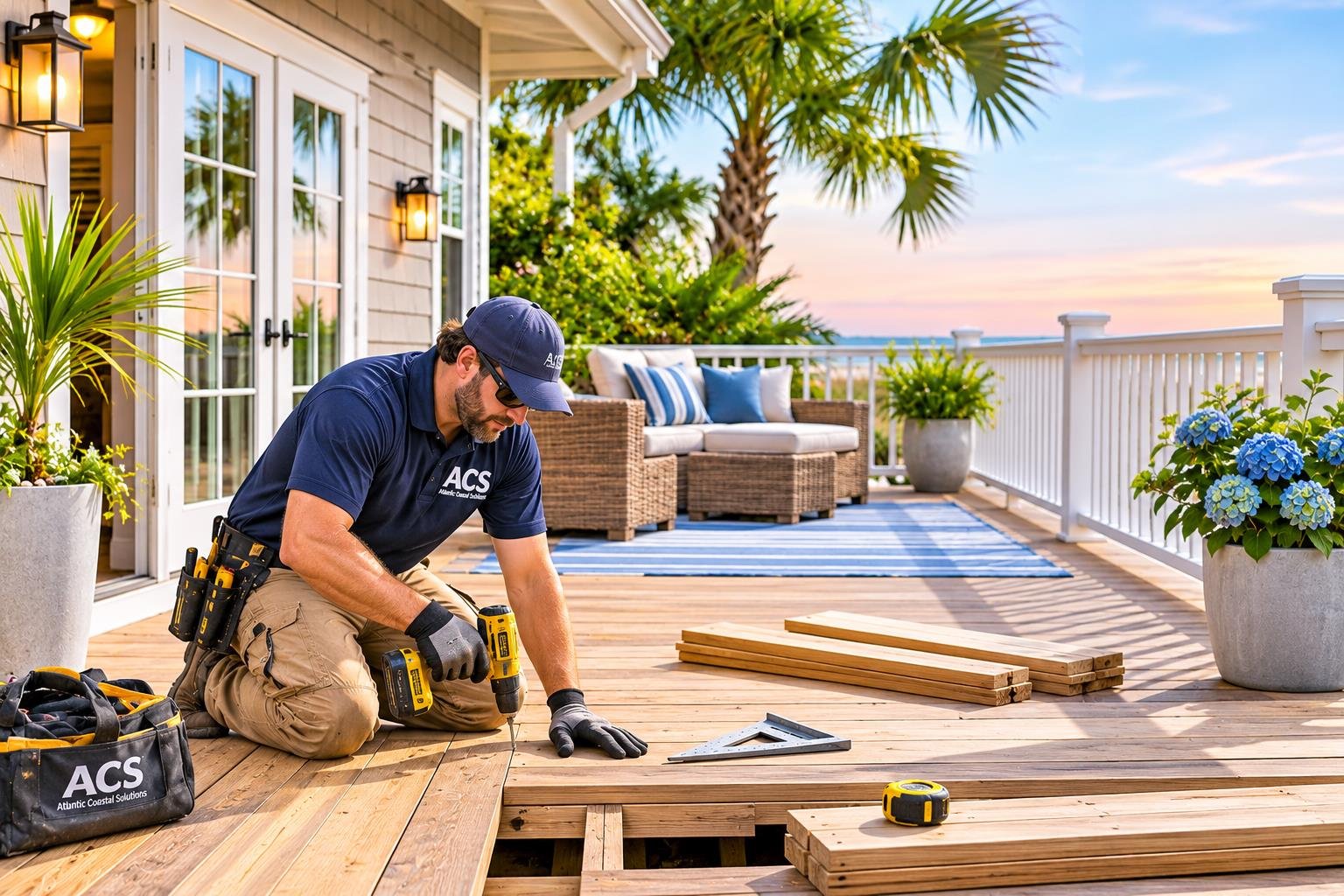
Your deck may be the first place you visit on a sunny morning and the last place you relax before heading indoors. For many Surf City homeowners, it serves as an outdoor dining room, a gathering place, and a comfortable spot to enjoy the coastal breeze.
But what happens when the boards begin to splinter, the railing feels loose, or the entire structure starts showing its age?
Should you repair the existing deck or invest in a completely new one?
That decision is often the starting point for deck building and repair in Surf City NC. The right answer depends on the structure’s condition, your plans for the space, and the demands of coastal North Carolina’s environment.
A beautiful deck needs more than attractive boards. It also needs a sound foundation, reliable connections, appropriate materials, and a design that fits your lifestyle.
This guide helps Surf City homeowners evaluate existing decks, recognize important safety concerns, and make informed decisions about repairs or custom construction.
The First Decision: Is Your Existing Deck Worth Saving?
Before selecting new decking materials or planning an expansion, determine whether the existing structure remains suitable for continued use.
Some decks need only limited repairs. Others require more extensive work because deterioration affects structural components.
A faded surface does not automatically mean the deck needs replacement. Similarly, a deck that looks attractive from above may still have problems underneath.
Therefore, a meaningful assessment should consider the entire structure.
When Targeted Deck Repairs May Make Sense
A repair may be appropriate when the main structure remains sound and the damage is limited.
For example, individual boards may have become cracked or worn while the supporting framing remains in acceptable condition.
Likewise, some localized trim or stair components may be repairable.
However, a qualified professional should determine whether the existing structure can safely support the proposed work.
When a Complete Rebuild Deserves Consideration
Replacement may become more practical when deterioration affects multiple structural components.
For example, extensive decay, inadequate connections, or widespread framing problems can make isolated repairs insufficient.
Additionally, homeowners sometimes discover that the existing layout no longer meets their needs.
In that situation, rebuilding may provide an opportunity to improve both the structure and the design.
Important: If a deck moves unexpectedly, has unstable railings, or shows signs of serious structural damage, stop using it until an appropriately qualified professional evaluates it.
Seven Warning Signs That Deserve Attention
Deck problems often develop gradually. Consequently, homeowners may overlook early signs until they become more noticeable.
Look for these conditions during a safe, ground-level inspection.
1. Soft or deteriorating boards
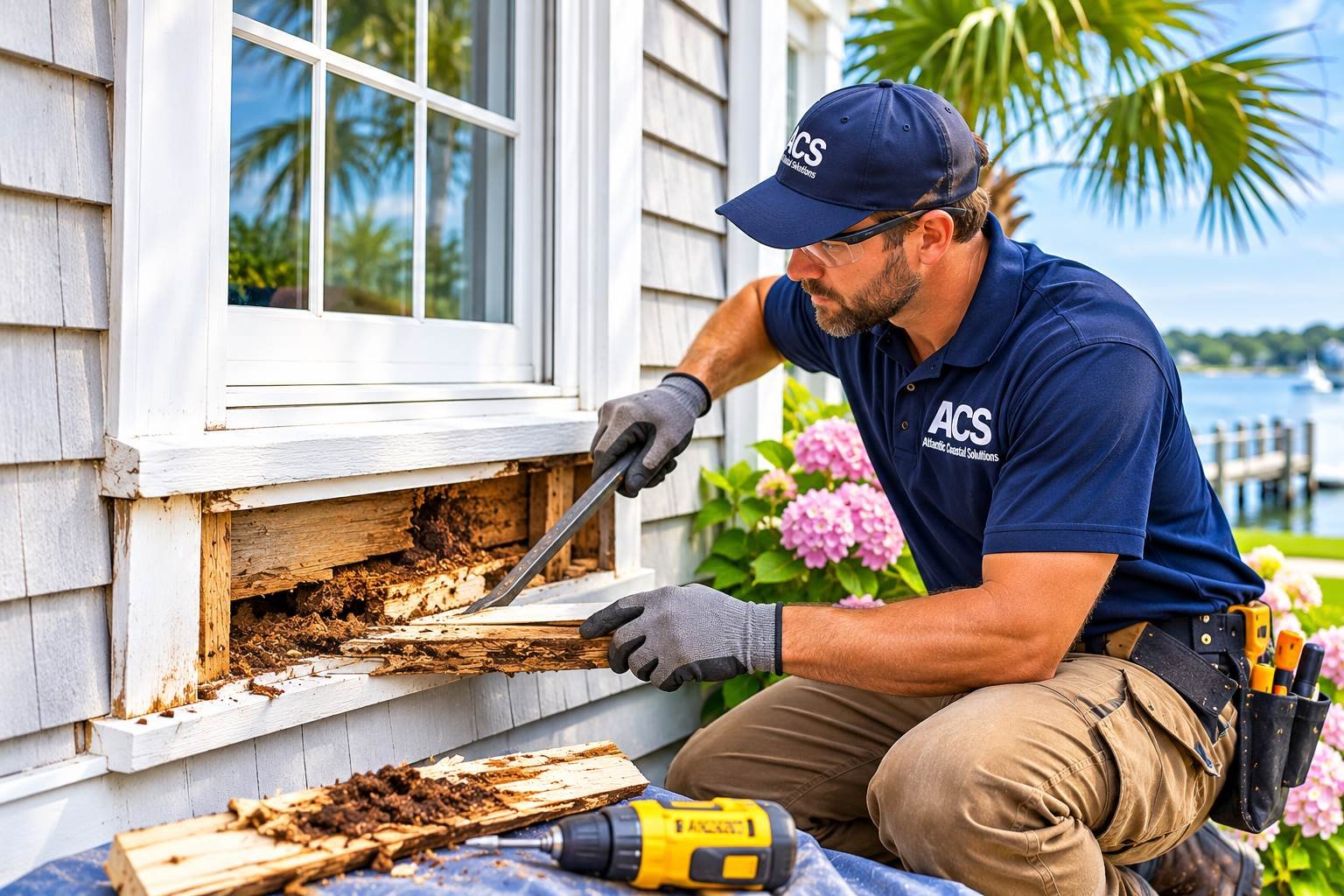
Wood that feels unusually soft or shows visible decay may need further evaluation. However, do not probe or walk on a visibly unsafe area.
2. Loose railings
A railing that moves when lightly touched may have compromised connections. Because guardrails help prevent falls, this deserves prompt professional attention.
3. Corroded connectors
Rust or other visible corrosion around structural hardware may indicate deterioration. The severity depends on the material, exposure, and condition.
4. Uneven or damaged stairs
Loose treads, deteriorated stringers, and unstable handrails can create hazards.
5. Unusual movement
Excessive bouncing, shifting, or noticeable movement may indicate structural concerns.
6. Problems where the deck meets the house
The connection between an attached deck and the building is particularly important. Deterioration or improper attachment may require specialist evaluation.
7. Standing water and persistent dampness
Repeated water accumulation can accelerate deterioration and may indicate drainage or construction problems.
These signs do not all require the same repair. Nevertheless, they provide useful reasons to arrange a professional inspection.
Beneath the Boards: What Actually Supports a Deck?
Homeowners naturally notice the surface first. However, the components beneath the decking play a major role in structural performance.
Understanding their basic functions can make contractor discussions more productive.
Footings and Posts
Footings transfer loads to suitable supporting ground. Posts carry loads from the elevated structure.
Their dimensions, locations, and connections must suit the approved design.
Beams and Joists
Beams and joists support the deck’s walking surface.
However, their required sizes and spacing depend on factors such as spans, materials, and loading conditions.
Connections and Fasteners
Connectors help transfer forces between structural components.
Therefore, the type, placement, and compatibility of fasteners matter.
Decking and Guards
Deck boards create the walking surface, while guards and handrails provide important safety functions where required.
A deck can have new boards while retaining inadequate structural connections underneath.
Consequently, replacing the visible surface alone does not guarantee that the entire deck is safe.
For technical background, the American Wood Council’s deck construction resources explain important principles of residential wood deck design.
These resources provide general guidance; the applicable North Carolina code and approved project design govern actual construction.
Designing a New Deck Around the Way You Live
A custom deck should reflect the activities you want to enjoy, not simply fill the available space.
Consider how the deck will function on an ordinary weekday as well as during larger gatherings.
A Quiet Morning Deck
Some homeowners want a simple retreat with space for two chairs and a small table.
In that case, the design may prioritize views, convenient access, and comfortable circulation.
A compact deck can still feel welcoming when its proportions suit the home.
A Family Dining Deck
A household that frequently eats outside may need room for a dining table and chairs.
However, furniture should not obstruct stairs or required exits.
Additionally, the layout must account for the intended loads and suitable structural design.
A Multi-Level Outdoor Experience
On some properties, different deck levels can define separate activities.
For example, one area may serve as a lounge while another connects to the yard.
However, changes in elevation introduce additional stair, guard, accessibility, and structural considerations.
A Deck for a Vacation Property
Vacation rental owners may prioritize straightforward circulation, durable finishes, and easily maintained components.
Nevertheless, rental use can introduce additional requirements that should be evaluated for the specific property.
The best design balances everyday comfort with safe construction.
Coastal Materials: Look Beyond the Showroom Sample
Surf City’s coastal environment influences how exterior materials perform over time.
Sunlight, rainfall, humidity, and salt-laden air can all affect a deck.
However, no single decking product is automatically the best choice for every property.
Pressure-Treated Wood
Properly specified pressure-treated lumber remains a common option for outdoor structures.
It can provide a traditional appearance and may be suitable for both structural and decking applications, depending on its treatment rating and intended use.
However, homeowners should expect routine maintenance.
Additionally, treated wood must be paired with compatible connectors and fasteners.
Composite Decking
Composite decking offers an alternative to traditional wood boards.
Some products provide resistance to certain forms of deterioration and require less routine surface finishing.
Nevertheless, composites vary in heat retention, expansion, span requirements, and installation methods.
Therefore, follow the specific manufacturer’s instructions.
PVC Decking
Certain PVC decking products are designed for exterior use and offer different moisture-related characteristics from wood.
However, appearance, movement, temperature response, and structural support requirements vary by product.
Naturally Durable Wood Species
Some naturally durable woods can provide a distinctive appearance.
However, natural durability does not eliminate maintenance or guarantee suitability for every exposure.
Furthermore, material sourcing, cost, and finish requirements may influence the decision.
For Surf City homes, the right material is the one that suits the approved design, expected exposure, maintenance preferences, and budget.
The Coastal Connection Problem: Why Hardware Matters
A deck contains numerous connections that homeowners rarely notice.
Yet those connections help hold the structure together.
Salt exposure can accelerate corrosion on unsuitable metal hardware.
Additionally, certain preservative-treated wood products require compatible fasteners.
Therefore, a deck builder should select connectors and fasteners based on the specific materials and exposure conditions.
The American Wood Council’s prescriptive residential wood deck guide discusses structural connections and corrosion-resistant hardware.
However, this guide is based on an older model-code edition and is not a substitute for current local requirements.
For coastal properties, site-specific conditions and applicable code provisions may require different details.
This is one reason professional deck construction involves more than selecting attractive surface boards.
The Surf City Deck Design Review
Before approving a deck plan, evaluate the proposed structure from five perspectives.
1. Access
How will people enter and leave the deck?
Consider the connection to the house, stair locations, and access to the yard.
2. Sunlight
Which parts of the deck receive direct afternoon sun?
Furniture placement and suitable shade features may influence comfort.
3. Drainage
How will rainwater move across and away from the structure?
Appropriate spacing and drainage details can help prevent unnecessary water accumulation.
4. Privacy
Does the proposed layout overlook neighboring properties?
A thoughtful furniture arrangement or suitable screening feature may improve privacy.
However, any added structures must comply with applicable requirements.
5. Future Improvements
Do you expect to add lighting, an outdoor dining area, or another feature later?
Planning ahead can reduce the likelihood of unnecessary modifications.
For example, homeowners who anticipate future electrical features can discuss suitable provisions during the initial design.
Deck Repairs That Should Not Be Treated as Cosmetic Work
Some problems may look minor while affecting safety.
For example, a loose guardrail is not simply a finishing defect.
Likewise, a damaged support connection cannot necessarily be corrected by installing new decking boards.
Stair Repairs
Stairs need secure structural support and appropriate dimensions.
Therefore, repairing a damaged stair assembly may involve more than replacing individual treads.
Ledger and Attachment Repairs
Where a deck attaches to the house, the connection requires particular attention.
Water intrusion, improper fastening, or deterioration may affect the assembly.
Consequently, repairs should address the underlying cause rather than conceal it.
Support Post Repairs
Damaged posts or connections may affect the deck’s ability to carry loads.
Therefore, temporary support and structural repair methods should be determined by qualified professionals.
Guardrail Repairs
Guardrails must resist applicable loads and meet relevant requirements.
Simply tightening an accessible screw may not resolve an inadequate connection.
The priority should always be structural performance, not appearance alone.
What Happens During a Professional Deck Assessment?
A useful deck assessment begins with the homeowner’s concerns.
For example, you might report loose stairs, deteriorating boards, or a desire to expand the structure.
The contractor then evaluates accessible components and determines whether additional specialist assessment is necessary.
Depending on the project, the process may include reviewing:
- Visible decking and framing condition
- Railings and stairs
- Structural connections
- Moisture-related deterioration
- Existing foundations and supports
- Intended changes to deck size or use
- Applicable permit and inspection requirements
However, an ordinary visual assessment cannot reveal every concealed defect.
For example, damage behind a ledger connection may require further investigation.
Therefore, ask the contractor to explain the limitations of the inspection and any recommended next steps.
A New Deck Project: From Concept to Construction
Building a custom deck involves several coordinated decisions.
Although the sequence varies, homeowners can expect a process similar to the following.
Initial consultation: Discuss the proposed location, size, intended use, and preferred appearance.
Site evaluation: Review access, ground conditions, existing structures, and potential constraints.
Design development: Determine the deck configuration, framing approach, stairs, guards, and material specifications.
Permitting and approvals: Confirm applicable building, zoning, and coastal development requirements.
Construction: Complete foundations, framing, connections, decking, and other approved components.
Inspection: Arrange required inspections at the appropriate stages.
Final walkthrough: Review the finished work, maintenance guidance, and any remaining items.
Homeowners should confirm that work requiring approval has received the necessary inspections before regular use.
A Local Consideration: Permits and Coastal Property Restrictions
Deck construction in Surf City may involve building permits, zoning requirements, and site-specific restrictions.
Furthermore, properties near the ocean, dunes, or other regulated coastal areas may require additional review.
The correct requirements depend on the parcel and proposed work.
Therefore, homeowners should confirm approvals before removing or constructing structural components.
The North Carolina Office of State Fire Marshal’s current and past building-code resources provide official information about state code editions.
However, local officials determine which requirements apply to a particular project.
Additionally, some coastal properties may face restrictions beyond ordinary residential construction rules.
A qualified contractor can help homeowners identify the necessary approval process.
Where Deck Project Budgets Often Change
A deck estimate involves more than the number of square feet.
For example, replacing boards on a sound structure differs significantly from rebuilding an elevated deck with new foundations and stairs.
Several factors influence the scope:
Structural condition: Hidden deterioration can require additional work.
Elevation: Taller decks may need more complex framing, access, and safety features.
Materials: Different decking and railing systems have different costs and installation requirements.
Site access: Limited access can affect labor and equipment needs.
Stairs and railings: These components add materials, labor, and design requirements.
Permits and inspections: Applicable approvals form part of the project.
Demolition and disposal: Removing an existing structure may add costs.
Therefore, compare written estimates based on their included work rather than the total price alone.
A lower estimate may exclude necessary preparation, disposal, or finishing details.
Make Deck Maintenance a Seasonal Habit
Even a well-built deck requires ongoing attention.
However, maintenance should match the actual materials and exposure conditions.
Early Spring
Inspect accessible boards, stairs, and railings for visible damage.
Additionally, remove accumulated debris where safe.
Summer
Clean the deck using methods approved by the material manufacturer.
For example, some surfaces require specific cleaning products or procedures.
Autumn
Clear leaves and debris that may retain moisture.
Furthermore, observe whether water collects in particular areas after rainfall.
After Severe Coastal Weather
When conditions are safe, inspect for displaced boards, loose components, and visible structural damage.
However, do not use a deck that appears unstable.
Instead, arrange a qualified assessment.
Routine maintenance can help identify developing problems, but it does not replace professional structural inspections.
Turn a Deck Into a More Useful Outdoor Space
A deck doesn’t need elaborate features to improve everyday living.
Sometimes, a better furniture arrangement makes the greatest difference.
For example, placing a dining table near the house may simplify outdoor meals.
Meanwhile, a separate seating area can create a quieter place to relax.
Suitable lighting may also improve evening use, provided electrical work follows applicable requirements.
For homeowners planning additional home improvements, Atlantic Coastal Solutions’ handyman services in Wilmington, NC page offers related property maintenance information.
However, structural deck construction and major repairs require appropriately qualified professionals.
The goal is to create a space that looks attractive while remaining practical and safe.
The Deck You Enjoy Should Also Be the Deck You Trust
A well-designed deck can make coastal living more enjoyable.
However, attractive boards and comfortable furniture cannot compensate for structural problems.
For homeowners considering deck building and repair in Surf City NC, the first step is understanding the existing structure or developing an appropriate design for a new one.
From safe connections and coastal material selection to thoughtful layouts and maintenance, every decision contributes to the finished result.
Atlantic Coastal Solutions supports home improvement and property maintenance projects in Surf City and surrounding coastal North Carolina communities.
Planning a deck improvement or concerned about an existing structure? Visit the Atlantic Coastal Solutions homepage to explore the company and its services, then discuss your project needs with the team.