A small patch of peeling paint beneath a window may not seem urgent. Perhaps the trim feels slightly soft, or a porch post has developed an unusual crack. From a distance, the house still looks perfectly maintained.
Unfortunately, the visible damage may be only part of the problem.
In Wrightsville Beach, exterior woodwork faces frequent rainfall, humid conditions, wind-driven moisture, and salt-laden coastal air. When water repeatedly enters vulnerable construction details and the wood cannot dry properly, decay may develop.
That’s why wood rot repair in Wrightsville Beach NC should begin with investigating the cause, not simply covering the damaged area.
The goal is to identify affected materials, correct the moisture problem, and restore the property’s condition with appropriate repair methods.
This homeowner’s field guide follows the clues that wood deterioration leaves behind, explains how professionals investigate them, and helps property owners understand which repairs deserve immediate attention.
The First Clue: A Window That Looks Fine Until You Look Closer
Imagine noticing a narrow strip of peeling paint beneath an upstairs window.
At first, it appears to be a cosmetic problem.
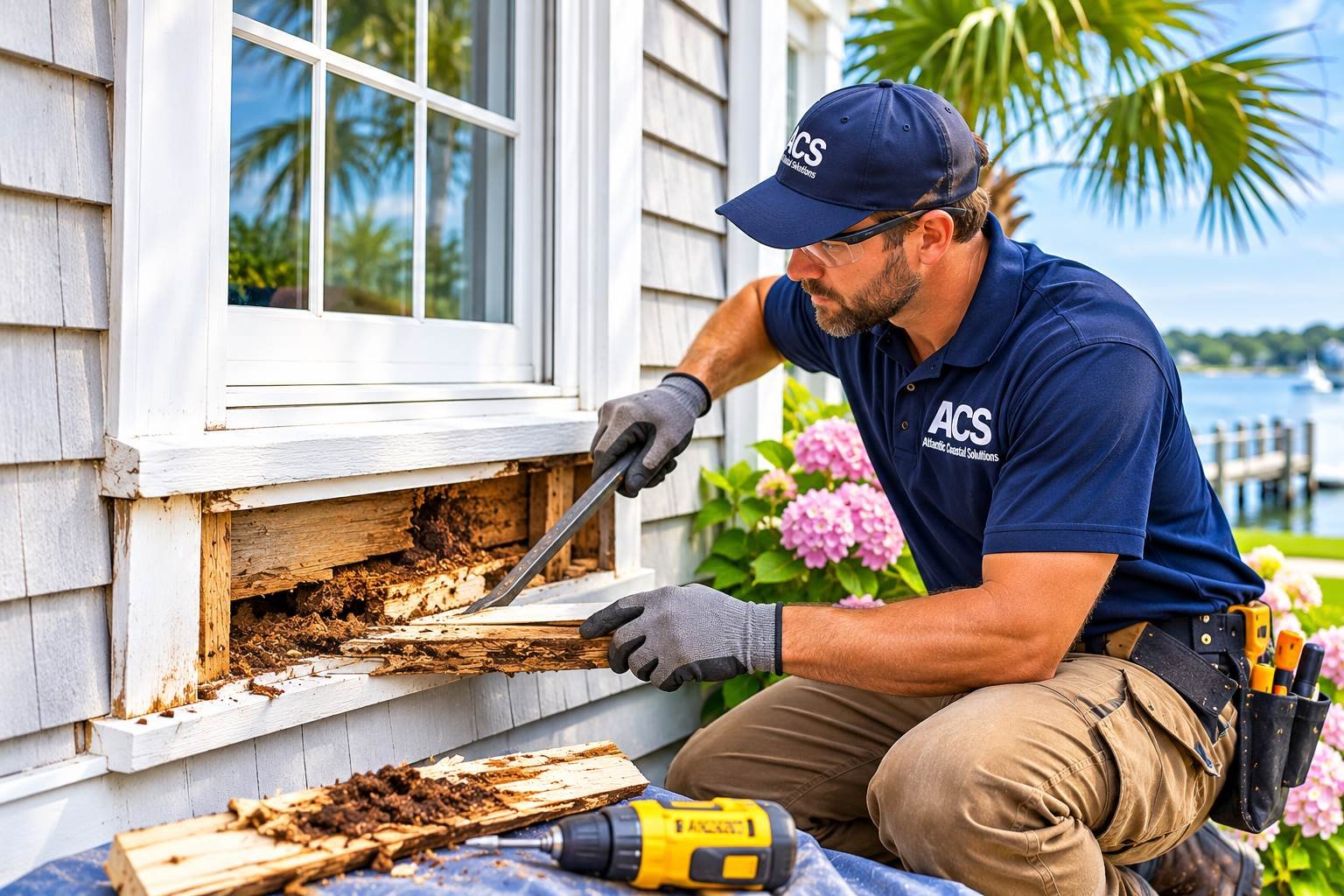
However, a closer inspection reveals dark discoloration near the corner of the sill. The paint has started separating from the wood, and the surrounding trim looks slightly swollen.
What might this indicate?
Several possibilities deserve investigation.
Water could be entering through deteriorated sealant, damaged flashing, or another opening in the exterior assembly. Alternatively, condensation or a different moisture source may be involved.
The visible paint failure does not prove that the wood has rotted.
Nevertheless, it provides a reason to investigate.
The key distinction: Peeling paint is a symptom. Wood decay is a material condition. Moisture intrusion may be the underlying cause of either.
Treating all three as the same problem can lead to ineffective repairs.
Follow the Moisture, Not Just the Damage
Wood-decaying fungi require suitable environmental conditions, including sufficient moisture.
Therefore, moisture management is central to preventing deterioration.
According to research published by the USDA Forest Products Laboratory, wood decay depends on conditions that support wood-degrading organisms, particularly moisture availability.
However, a single high moisture reading does not automatically establish that structural decay has occurred.
A professional assessment considers the material, exposure history, visible condition, and other evidence.
For further technical background, the USDA Forest Products Laboratory’s research on wood biodeterioration explains the biological processes involved.
Where Does the Water Come From?
In a coastal home, moisture can enter or accumulate through several pathways.
Wind-driven rain: Water may reach vulnerable joints and openings during severe weather.
Window and door details: Defective flashing, sealant, or installation details can allow water intrusion.
Roof drainage problems: Overflowing gutters or poorly directed runoff may repeatedly wet exterior components.
Plumbing leaks: Water from concealed pipes can affect nearby wood framing.
Poor drainage: Water collecting near foundations or lower wall components may contribute to deterioration.
Condensation: Under certain conditions, moisture may accumulate on or within building assemblies.
Because these sources require different solutions, identifying the actual pathway is essential.
The Wood Rot Investigation: Five Places to Examine
A professional inspection often follows the path water is most likely to take.
For Wrightsville Beach properties, these five locations deserve particular attention.
Evidence Area 1: Window Sills and Lower Corners
Window assemblies contain several joints where different materials meet.
For example, the lower corners may experience repeated wetting when drainage details fail.
Possible warning signs include:
- Swollen or distorted trim
- Peeling or blistering paint
- Dark staining
- Soft or crumbling wood
- Gaps at exterior joints
However, staining alone does not confirm decay.
Additionally, the visible sill may not reveal the condition of concealed framing.
Therefore, the inspection may need to extend beyond the surface.
Evidence Area 2: Exterior Door Frames and Thresholds
Exterior doors experience regular use and weather exposure.
Consequently, deterioration may appear near lower jambs, thresholds, or adjacent trim.
For example, a damaged threshold detail may allow moisture to reach surrounding materials.
However, the correct repair depends on the extent of damage and the door assembly’s construction.
A complete assessment should also consider whether the door opens, closes, and seals correctly.
Evidence Area 3: Porch Posts and Rail Connections
Porches often contain wood components exposed to outdoor conditions.
However, the level of exposure varies according to roof coverage and design.
A decorative trim board may require a relatively straightforward repair.
In contrast, decay affecting a load-bearing porch post or critical connection can create a serious safety concern.
Therefore, homeowners should not treat structural deterioration as an ordinary cosmetic defect.
If a porch component appears unstable, restrict access until a qualified professional evaluates it.
Evidence Area 4: Fascia and Roofline Trim
Fascia boards and related roofline components can experience repeated moisture exposure.
For example, damaged gutters or flashing may direct water toward vulnerable woodwork.
Additionally, water can enter behind exterior trim where construction details are inadequate.
Because roofline work may involve significant fall hazards, homeowners should arrange professional inspection rather than climbing to investigate.
Evidence Area 5: Lower Siding and Foundation Transitions
Wood near the ground may experience moisture from rain splash, drainage problems, or nearby landscaping.
For example, mulch piled against exterior siding can conceal deterioration and retain moisture.
Therefore, suitable separation between exterior woodwork and surrounding ground conditions matters.
NC State Extension’s preventative home maintenance guide recommends inspecting exterior trim, window frames, siding, drainage, and other vulnerable components regularly.
What Wood Rot Actually Looks Like
Not every dark patch is rot, and not every deteriorated board looks the same.
Wood-decaying fungi can produce different patterns of material breakdown.
Brown Rot
Brown rot can cause wood to become darker, brittle, and cracked.
In advanced cases, the material may break into block-like pieces.
However, the appearance varies with the wood species and stage of deterioration.
White Rot
White rot may leave wood looking pale, fibrous, or softened.
Nevertheless, visual appearance alone may not identify the exact organism responsible.
Surface Mold Versus Wood Decay
Surface mold and structural wood decay are not interchangeable terms.
Mold may grow on a material’s surface without causing the same structural breakdown associated with wood-decaying fungi.
However, both can indicate moisture conditions that require attention.
A professional may need to distinguish between surface contamination, staining, insect damage, and actual loss of wood strength.
For homeowners, the safest approach is to avoid making a structural judgment from color alone.
A Critical Question: How Deep Does the Damage Go?
The visible area of deterioration does not always match the full extent of damage.
For example, a small section of damaged window trim may conceal moisture behind the exterior finish.
Conversely, a large area of peeling paint may not involve significant wood decay.
Therefore, repair decisions should follow an appropriate assessment.
A contractor may begin with visual observations and moisture measurements.
Depending on the findings, further investigation may be necessary.
Moisture Meters
Moisture meters can help identify areas with elevated moisture readings.
However, readings depend on the device, material, and testing method.
Consequently, a single measurement should not be treated as definitive proof of decay.
Infrared Imaging
Infrared cameras can reveal surface temperature patterns that may indicate areas worth investigating.
However, they do not directly see through walls or confirm the presence of rot.
A suspected moisture anomaly generally requires verification using appropriate methods.
Selective Opening of Materials
Sometimes, concealed damage cannot be assessed without carefully removing part of the finish.
For example, an exterior trim board may need to be removed to examine the underlying assembly.
However, destructive investigation should be planned and performed by qualified professionals.
The objective is to understand the problem without causing unnecessary additional damage.
The Repair Decision: Surface Restoration or Material Replacement?
Once the affected area and moisture source are understood, the contractor can develop an appropriate repair plan.
The method depends on the condition and function of the component.
Case One: The Wood Is Sound, but the Finish Has Failed
Suppose the paint is peeling, but inspection confirms that the underlying wood remains suitable for continued use.
In that situation, the project may involve correcting the moisture issue and restoring the surface finish.
However, coating work should begin only when conditions and substrate preparation meet product requirements.
Case Two: A Small Nonstructural Section Has Deteriorated
A localized section of decorative trim may sometimes be repaired or replaced without removing an entire assembly.
Nevertheless, the contractor should confirm that the surrounding material remains sound.
Additionally, any moisture pathway must be corrected.
Case Three: A Larger Section Requires Replacement
Extensive deterioration may make replacement more practical.
For example, a damaged exterior board may need removal and installation of a suitable new component.
However, the repair should also address relevant flashing, drainage, or weather-resistance details.
Case Four: The Damage Affects a Structural Component
Decay in beams, joists, load-bearing posts, or other structural members requires special attention.
Such work may involve temporary support, engineered repair details, permits, or inspections.
Therefore, homeowners should use appropriately qualified professionals.
Cosmetic fillers and coatings are not substitutes for structural repairs.
Why Painting Over Rotten Wood Usually Fails
Fresh paint can improve the appearance of a weathered exterior.
However, paint cannot restore the strength of wood that has suffered significant decay.
If the underlying moisture problem continues, deterioration may progress beneath the new finish.
For example, painting a damaged window sill without correcting the source of water intrusion may leave the original problem unresolved.
Similarly, applying caulk over a deteriorated joint may conceal damage rather than repair it.
Therefore, the correct sequence matters.
First, identify the cause.
Next, determine the condition of the affected material.
Then, complete the necessary repairs.
Finally, prepare and finish the surface according to the selected products’ requirements.
This approach addresses the building condition rather than only its appearance.
A Wrightsville Beach Repair Scenario: The Porch Column
Consider a hypothetical homeowner who notices peeling paint near the bottom of a porch column.
The homeowner initially plans to sand and repaint the affected area.
However, an inspection reveals that the outer decorative wrap has trapped moisture.
The repair approach now depends on what lies underneath.
If the decorative wrap is damaged but the structural post remains sound, the project may involve replacing the affected finish materials and correcting the water-trapping detail.
If the load-bearing post has deteriorated, the work becomes a structural repair.
In that situation, a qualified professional must determine how to support and restore the assembly safely.
The example demonstrates why the same visible symptom can lead to very different repair scopes.
What matters is not simply how the wood looks, but what the component does and why it deteriorated.
Choosing Replacement Materials for a Coastal Property
When replacement becomes necessary, homeowners often ask whether wood, engineered materials, or exterior composites offer the best solution.
The answer depends on the application.
For example, a decorative fascia board and a load-bearing structural post have different performance requirements.
Properly Specified Exterior Wood
Suitable wood products can provide a traditional appearance.
However, the species, treatment, exposure, and finishing requirements matter.
Additionally, some applications require preservative-treated or naturally durable materials under applicable codes.
Engineered Exterior Trim
Certain engineered trim products are manufactured for exterior applications.
However, their suitability depends on product specifications and installation details.
Therefore, homeowners should verify whether the product is approved for the intended location.
Cellular PVC and Other Composite Trim
Some exterior trim products offer alternatives to traditional wood for nonstructural applications.
However, they may have specific requirements for fastening, movement, painting, and temperature exposure.
Furthermore, decorative trim products should not be assumed to replace structural framing.
Fasteners and Connections
Coastal exposure may accelerate corrosion.
Consequently, replacement components should use compatible hardware appropriate for the environment.
The best repair combines suitable materials with sound construction details.
The Hidden Cost of Delaying Repairs
A small damaged trim board may appear to be an isolated maintenance issue.
However, unresolved moisture intrusion can affect additional materials.
For example, water entering around a window may eventually damage surrounding finishes or concealed components.
Likewise, persistent moisture near a porch connection may create more extensive repair needs.
Nevertheless, not every visible defect indicates widespread hidden damage.
Therefore, homeowners should avoid assuming the worst while also avoiding unnecessary delays.
A timely assessment can clarify the actual condition and help establish an appropriate repair scope.
How to Review a Wood Rot Repair Proposal
A useful repair proposal should explain more than the price of replacing visible wood.
Before approving the project, ask whether the contractor has identified the likely moisture source.
Then review the proposed work carefully.
The scope should clarify which components will be removed, repaired, or replaced.
Additionally, it should identify the proposed replacement materials and relevant finishing work.
For concealed conditions, ask how unexpected damage will be documented and priced if discovered.
If the repair involves structural elements, confirm how applicable engineering, permits, and inspections will be addressed.
Finally, ask whether the work includes appropriate cleanup and a final walkthrough.
A clear proposal helps homeowners understand both the immediate repair and the steps intended to reduce recurrence.
Preventing Another Repair: A Property Maintenance Calendar
Wood rot prevention works best when homeowners make moisture management part of routine property care.
Rather than waiting for visible deterioration, inspect vulnerable areas throughout the year.
Spring: Check Exterior Openings
Look for damaged paint, loose trim, and deteriorated joints around windows and doors.
Additionally, note any areas that appear persistently damp.
Summer: Watch Moisture-Prone Locations
Observe areas where water collects or where vegetation restricts drying.
However, avoid making structural assessments from ground-level observations alone.
Autumn: Review Drainage
Keep gutters and downspouts in suitable working condition.
Additionally, ensure runoff does not repeatedly collect against vulnerable building components.
After Major Storms: Look for Changes
When conditions are safe, inspect accessible exterior surfaces for new damage.
For example, displaced trim or damaged roofline components may require attention.
However, do not climb onto damaged roofs or enter unsafe areas.
NC State Extension also provides practical guidance on preventing moisture problems in homes, including the importance of drainage and properly detailed exterior assemblies.
The Difference Between Wood Rot and Termite Damage
Wood decay and termite activity can sometimes produce confusing visual symptoms.
However, they involve different processes.
Wood rot results from biological deterioration associated with wood-decaying organisms and suitable environmental conditions.
Termites, by contrast, are insects that feed on wood and other cellulose-containing materials.
Although moisture conditions may contribute to both problems, the appropriate response differs.
For example, suspected termite activity may require evaluation by a licensed pest management professional.
Meanwhile, deteriorated structural wood may require repair regardless of the original cause.
Therefore, do not assume that applying a wood treatment will resolve every form of deterioration.
An accurate diagnosis helps identify the correct next steps.
What Homeowners Can Safely Do Before a Contractor Arrives
If you notice suspected wood rot, there are several sensible steps you can take without disturbing the structure.
First, photograph the visible damage.
Next, note whether the area becomes wetter after rainfall.
Additionally, record any changes in nearby doors, windows, or finishes.
If the affected component appears structural or unstable, keep people away from the area.
Avoid removing load-bearing materials or attempting to reinforce damaged structures without professional guidance.
Furthermore, do not conceal the problem with fresh paint or filler before an assessment.
These observations can help a contractor understand the history of the damage.
Protect the Structure, Not Just the Surface
Wood rot repair is ultimately about protecting the building from continuing deterioration.
A successful project should address the affected material and the conditions that allowed damage to develop.
For homeowners seeking wood rot repair in Wrightsville Beach NC, that means looking beyond peeling paint, soft trim, or visible discoloration.
The important questions are straightforward: Where is the moisture coming from? How much material has been affected? Does the damage involve a structural component? What repair will address the problem appropriately?
Atlantic Coastal Solutions supports coastal property maintenance and home improvement needs in Wrightsville Beach and surrounding North Carolina communities.
If you’re concerned about deteriorating exterior woodwork, visit the Atlantic Coastal Solutions website to explore the company and discuss available assessment and repair options.
A timely investigation can help protect your coastal property before a small visible problem becomes a larger repair project.